


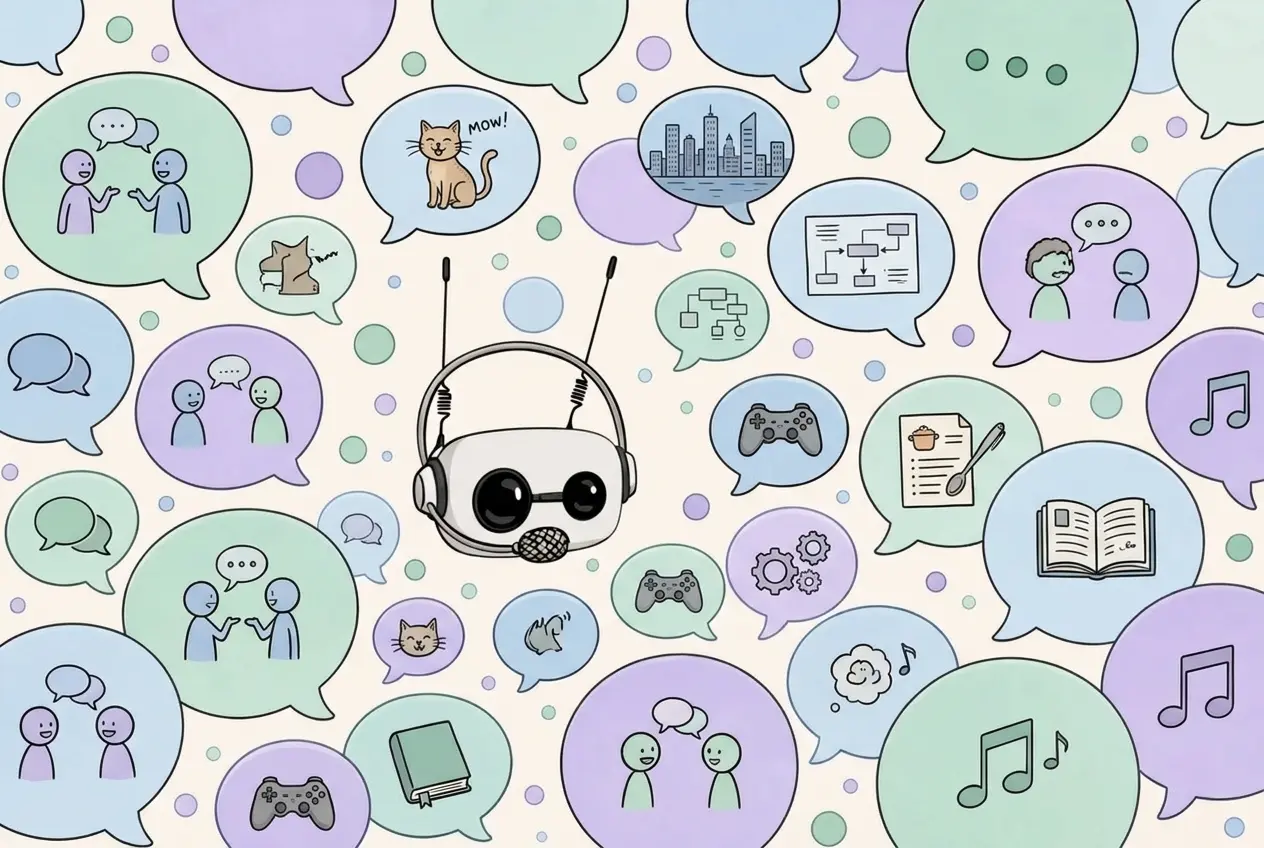
Reachy Mini can listen and talk back. Right now, that conversation runs on a single backend: Hugging Voice, our own open realtime voice engine. It's the same stack we use in production across the whole fleet, and it's the only one we support for now.
One backend, fully open
Reachy Mini's conversation currently supports only the open realtime voice backend described below. It's OpenAI-Realtime-compatible, so existing clients connect with a single line change, and it's fully open source and swappable.
Why build our own instead of just calling a hosted API? Scale and cost. A few lines straight from the team behind it:
We've shipped 9,000 Reachy Minis with conversation capabilities. Together, they now generate 15k hours of conversation every month. On GPT-realtime, that would cost at least $45k a month. So we built our own 'gpt-realtime': we reverse-engineered the OpenAI Realtime protocol, so existing clients connect with a single line change, but the backend is a fully open, end-to-end cascade we control - VAD, STT, LLM, and TTS, each swappable. Today, it costs us $0.25/hour to serve, and if you run it locally, which you can, it costs you nothing but electricity.
What that means for Reachy Mini today:
- One-line migration. The engine speaks the exact same protocol as OpenAI's realtime API, so switching a client is just changing the URI.
- Swappable models. The voice layer never changes; only the text-in, text-out LLM in the middle does. Hosted provider, HF Inference Providers, or a local vLLM / llama.cpp / MLX model - your choice.
- Runs locally. The whole cascade can run on your own machine, so conversation audio never has to leave the robot's network.
Want the full story?
This post is just the headline. The engineering deep dive - how they reverse-engineered the Realtime API, the latency budget, tool calling, barge-in, and multilingual support - lives in the original article:
An Open Realtime Voice You Can Actually Run Yourself
The code is open source (Apache 2.0) at huggingface/speech-to-speech. Point your existing Realtime client at it, or run the whole thing on your laptop tonight.